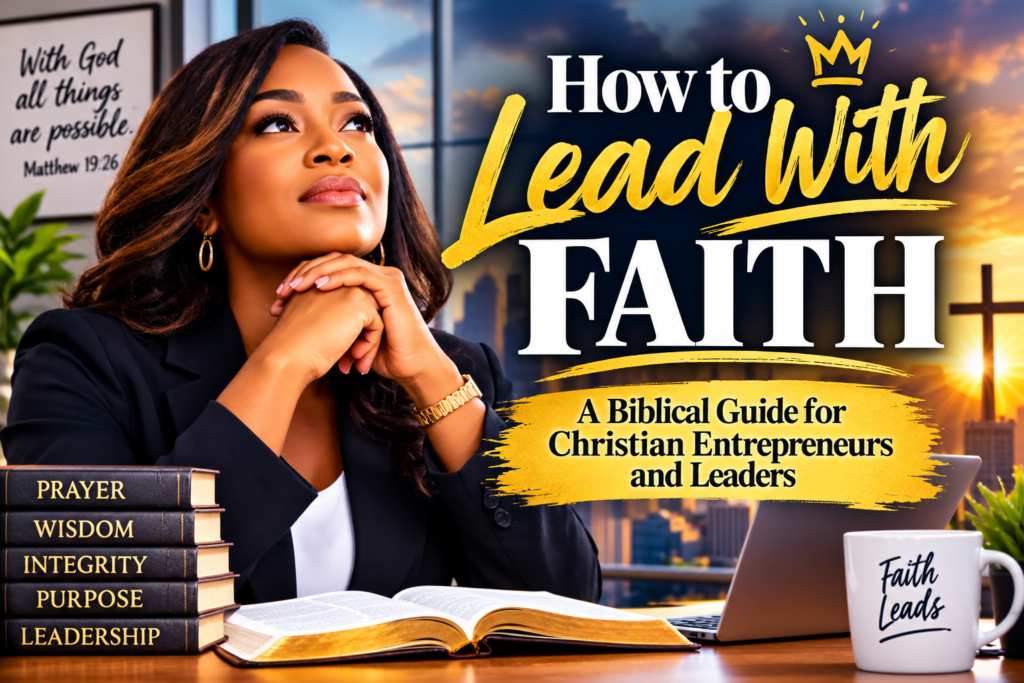
You didn’t start this business or step into this leadership role for money alone.
There was a calling behind it. A sense that God was in it. A conviction that what you were building was connected to something larger than profit margins, market share, or personal achievement.
But somewhere in the daily grind of decisions, deadlines, team dynamics, cash flow pressures, and the relentless demands of growth the faith that launched you can feel distant from the leadership you’re actually doing.
The meetings don’t feel sacred. The strategy sessions don’t feel Spirit-led. The hard conversations don’t feel grace-filled. And the gap between the leader you sense God calling you to be and the leader you are on a Tuesday afternoon when everything is going sideways that gap can feel enormous.
You are experiencing one of the most common and most significant challenges facing Christian leaders and entrepreneurs today: the integration of genuine faith into the practical, messy, high-stakes reality of leading people and building things.
If that resonates, you are not alone. And you are not failing.
This post is about closing that gap — not with platitudes, but with biblical clarity and practical tools for leading with faith in the real world.
“Whatever you do, work at it with all your heart, as working for the Lord, not for human masters, since you know that you will receive an inheritance from the Lord as a reward. It is the Lord Christ you are serving.” — Colossians 3:23-24
What It Actually Means to Lead With Faith
Leading with faith is not the same as leading with optimism. It is not the same as praying before meetings and hoping for the best. It is not the same as being nice, being passive, or avoiding hard decisions because you don’t want to seem unspiritual.
Leading with faith means:
Your authority comes from calling, not from title. You lead because God has placed you in this position not merely because you earned it, inherited it, or built it. That changes how you hold your authority with humility, with stewardship, and with a sense of accountability that goes beyond your board, your investors, or your team.
Your strategy is submitted to God’s wisdom. You plan, you analyze, you make wise decisions and you hold all of it with open hands, submitted to a God whose perspective and purposes are higher than yours.
Your character is the foundation of your leadership. In the Kingdom economy, who you are matters more than what you achieve. The fruit of your leadership the culture you create, the people you develop, the values you model is the true measure of faithfulness.
Your success is defined by faithfulness, not just outcomes. You steward the responsibility God has given you with excellence and integrity and you trust Him with the results.
Your leadership serves people, not just goals. Every person on your team, in your community, or under your influence is an image-bearer of God deserving of dignity, development, and genuine care.
The Biblical Blueprint for Faithful Leadership
Foundation 1: Servant Leadership The Kingdom Model
“Not so with you. Instead, whoever wants to become great among you must be your servant, and whoever wants to be first must be your slave just as the Son of Man did not come to be served, but to serve, and to give his life as a ransom for many.” Matthew 20:26-28
Jesus didn’t just teach servant leadership. He modeled it washing feet, welcoming children, eating with outcasts, spending His final hours caring for His disciples rather than protecting His own comfort.
This is not weakness. It is the most powerful form of leadership ever demonstrated and the most countercultural thing a leader can do in a world that equates greatness with being served.
Servant leadership asks: “How can I use my position, resources, and influence to develop and empower the people I lead rather than to extract value from them?”
This question, taken seriously, transforms everything about how you hire, how you communicate, how you handle failure on your team, how you make decisions, and what you celebrate.
Foundation 2: Integrity Character Under Pressure
“Whoever can be trusted with very little can also be trusted with much, and whoever is dishonest with very little will also be dishonest with much.” Luke 16:10
“The integrity of the upright guides them, but the unfaithful are destroyed by their duplicity.” Proverbs 11:3
Integrity is not just about avoiding obvious ethical violations. It is the alignment between your private self and your public self between what you say and what you do, between your stated values and your actual decisions when the pressure is on.
Faith-led leaders are the same person in the boardroom as they are at home, as they are in prayer, as they are when no one is watching. That consistency over time, under pressure, in the small things as much as the large ones is both rare and profoundly powerful.
It also builds the kind of trust that no marketing strategy, no culture committee, and no leadership training program can manufacture.
Foundation 3: Wisdom Seeking God’s Perspective in Every Decision
“If any of you lacks wisdom, you should ask God, who gives generously to all without finding fault, and it will be given to you.” James 1:5
“Plans fail for lack of counsel, but with many advisers they succeed.” Proverbs 15:22
Faith-led leadership is not about ignoring data, analysis, or expertise and “just trusting God.” It is about bringing your best thinking informed by research, counsel, and experience into God’s presence, and holding it with humility rather than certainty.
It means praying before major decisions not as a ritual, but as a genuine act of dependence. It means seeking counsel from people wiser than you. It means being willing to change course when God makes it clear the plan needs to shift.
It also means that when the data is ambiguous, when the advisers disagree, and when the right path is unclear you have somewhere to turn beyond your own intelligence. And that is a profound leadership advantage.
Foundation 4: Vision Seeing What God Is Building
“Where there is no vision, the people perish.” Proverbs 29:18 (KJV)
Faith-led leaders are vision carriers. They have a sense however imperfectly articulated of what God is building through their work. Not just what they are building, but what He is building. Not just the product or the organization, but the Kingdom purpose it serves.
“Write the vision; make it plain on tablets, so he may run who reads it.” Habakkuk 2:2
This vision gives meaning to the mundane. It gives context to the setbacks. It gives direction when the path is unclear. And it creates the kind of magnetic, motivating leadership culture that inspires people to give their best because they understand that what they’re doing matters beyond the bottom line.
Foundation 5: Character Development Leading Yourself First
“Watch your life and doctrine closely. Persevere in them, because if you do, you will save both yourself and your hearers.” 1 Timothy 4:16
“Better a patient person than a warrior, one with self-control than one who takes a city.” Proverbs 16:32
You cannot lead others further than you have gone yourself. The internal work the mindset renewal, the emotional maturity, the character development, the spiritual depth is not separate from your leadership effectiveness. It is the foundation of it.
The leader who is not growing personally will eventually plateau organizationally. The leader who is not addressing their own blind spots, wounds, and patterns will reproduce those patterns in the culture they lead. The leader who has not learned to lead themselves their emotions, their reactions, their time, their energy will struggle to lead others well under pressure.
Leading with faith begins with the ongoing, honest, humble work of self-leadership.
8 Practical Steps to Lead With Faith Every Day
Step 1: Start Every Day in God’s Presence Before the Demands Begin
The single most consistent practice of faith-led leaders across history is beginning the day in God’s presence before the day begins in earnest.
“Very early in the morning, while it was still dark, Jesus got up, left the house and went off to a solitary place, where he prayed.” Mark 1:35
Jesus with the weight of the world’s redemption on His shoulders, with crowds pressing in from every direction, with limited time and unlimited demands began every significant day in prayer. Not after the demands. Before them.
Practical action: Protect the first 20-30 minutes of your day for God before email, before strategy, before anything else. Bring your leadership, your team, your decisions, and your challenges to Him before the day shapes them around you. This one practice, sustained consistently, will transform the quality of your leadership more than almost anything else.
Step 2: Define Your Leadership Purpose Beyond Profit
Every faith-led leader needs a clear articulation of why they lead a purpose statement that goes beyond financial metrics and market position to the Kingdom contribution their work makes.
“For we are God’s handiwork, created in Christ Jesus to do good works, which God prepared in advance for us to do.” Ephesians 2:10
Your business or leadership role is not separate from your calling. It is an expression of it. The question is whether you have clearly articulated the Kingdom purpose your work serves and whether that purpose is shaping your daily decisions.
Practical action: Write a one-paragraph leadership purpose statement that answers: “Why has God placed me in this leadership role? What Kingdom impact is this work meant to have? Who is being served, developed, or blessed through what I’m building?” Review it quarterly. Let it filter your decisions.
Step 3: Lead With Transparency and Vulnerability
One of the most powerful and most countercultural things a faith-led leader can do is lead with genuine transparency admitting mistakes, acknowledging uncertainty, and being honest about the tensions and challenges of leadership rather than performing invulnerability.
“Therefore confess your sins to each other and pray for each other so that you may be healed.” James 5:16
“For when I am weak, then I am strong.” 2 Corinthians 12:10
Leaders who admit mistakes create cultures where mistakes are acknowledged and learned from rather than hidden. Leaders who ask for help create cultures where help is sought rather than avoided. Leaders who are honest about their limitations create teams that compensate for those limitations rather than pretending they don’t exist.
Vulnerability is not weakness. In a Kingdom leadership context, it is one of the greatest expressions of strength.
Practical action: In your next team meeting or significant leadership moment, practice one act of genuine transparency acknowledging a mistake, asking for input on a decision you’re uncertain about, or sharing a challenge you’re navigating. Notice the response.
Step 4: Make Decisions Through a Kingdom Filter
Before every significant leadership decision, run it through a Kingdom filter a set of questions that ensure the decision reflects Kingdom values, not just business logic.
“And whatever you do, whether in word or deed, do it all in the name of the Lord Jesus, giving thanks to God the Father through him.” Colossians 3:17
The Kingdom leadership decision filter:
- Does this decision honor God in its process and its outcome?
- Does this decision serve the people involved not just extract value from them?
- Is this decision consistent with the values we say we hold?
- Am I making this decision from fear and scarcity or from faith and abundance?
- Five years from now, will I be proud of having made this decision this way?
- What would I do if God were visibly present in this room right now?
Step 5: Invest in the Development of Your People
“And the things you have heard me say in the presence of many witnesses entrust to reliable people who will also be qualified to teach others.” 2 Timothy 2:2
Paul’s leadership model was explicitly developmental he invested in people who would invest in others. The multiplication effect of genuine people-development is one of the most powerful Kingdom leadership principles available.
Faith-led leaders don’t just use people to build their organizations. They build people developing their skills, their character, their capacity, and their confidence and trust that in doing so, they are building something that outlasts any organizational metric.
Practical action: Identify one person on your team or in your sphere of influence who has significant potential that is currently underdeveloped. Commit to a specific investment in their development over the next 90 days a conversation, a resource, a stretch assignment, a coaching relationship. Do it intentionally rather than accidentally.
Step 6: Handle Failure With Grace Yours and Others’
“For though the righteous fall seven times, they rise again, but the wicked stumble when calamity strikes.” Proverbs 24:16
How a leader handles failure their own and their team’s is one of the clearest indicators of whether their leadership is faith-led or fear-led.
Fear-led leaders create cultures where failure is hidden, blamed away, or punished. Faith-led leaders create cultures where failure is acknowledged honestly, learned from deeply, and recovered from with resilience because failure, in a Kingdom context, is rarely final.
Practical action: The next time something fails on your watch or someone on your team makes a significant mistake practice this three-part response:
- Acknowledge — name what happened clearly and without minimizing
- Learn — ask what can be taken from this that makes you and the team better
- Move — decide the next right action and take it without lingering in condemnation
Step 7: Build a Team of Advisers Who Will Tell You the Truth
“Plans fail for lack of counsel, but with many advisers they succeed.” Proverbs 15:22
“Wounds from a friend can be trusted, but an enemy multiplies kisses.” Proverbs 27:6
One of the greatest leadership vulnerabilities especially for founders and senior leaders is the echo chamber: surrounding yourself with people who tell you what you want to hear rather than what you need to hear.
Faith-led leaders actively cultivate relationships with people who will speak truth to them trusted advisers, mentors, peers, coaches who have the courage and the standing to challenge their assumptions, name their blind spots, and hold them accountable to the person and leader they say they want to be.
Practical action: Identify 2-3 people in your life who consistently tell you the truth even when it’s uncomfortable. Invest in those relationships. Give them explicit permission to challenge you. And if you don’t currently have those people make finding them a priority.
Step 8: Measure Success by Faithfulness Not Just Results
This final step is perhaps the most counter-cultural in the entire list and the most spiritually important.
“His master replied, ‘Well done, good and faithful servant! You have been faithful with a few things; I will put you in charge of many things. Come and share your master’s happiness!'” Matthew 25:21
The ultimate evaluation of your leadership will not come from your board of directors, your investors, your customers, or your industry. It will come from a God who is asking one primary question: Were you faithful with what I gave you?
This doesn’t mean outcomes don’t matter. It means that outcomes are God’s responsibility faithfulness is yours. And a leader who is genuinely faithful with their character, their people, their resources, their calling — can stand before God with confidence, regardless of whether the business achieved everything they hoped.
Practical action: At the end of each week, ask yourself: “Was I faithful this week? Did I lead with integrity? Did I invest in my people? Did I honor God in my decisions? Did I steward well what He entrusted to me?” Let faithfulness not just results be the measure you hold yourself to.
What Faith-Led Leadership Produces Over Time
When you commit to leading with faith consistently, imperfectly, and over the long haul here is what builds:
A culture of trust. People follow leaders they trust. And trust is built through consistent integrity, transparent communication, and genuine care for people over time.
A team that gives their best. People work hardest for leaders who genuinely invest in them, who lead with purpose beyond profit, and who create environments where they feel valued and developed.
A legacy beyond the organization. The businesses, ministries, and organizations that outlast their founders are almost always those built on the foundation of character, Kingdom purpose, and genuine people investment not just strategy and execution.
Personal peace under pressure. The leader who is leading from faith genuinely trusting God with outcomes, genuinely anchored in identity beyond results navigates the inevitable pressures of leadership from a fundamentally different place than the leader who is carrying it all alone.
Kingdom impact that multiplies. When you lead in a way that develops people, serves your community, and operates with integrity the impact extends far beyond your immediate sphere. It multiplies through the people you’ve developed, the culture you’ve created, and the example you’ve modeled.
You Were Called to Lead Lead Like You Were
The calling that brought you to this leadership role was not an accident. God placed you here with your specific gifts, your specific experience, your specific sphere of influence because He has a Kingdom purpose He wants to accomplish through you.
That purpose is too important to be led without faith. It is too significant to be built on anything less than the character, the integrity, the servant heart, and the Spirit-led wisdom that Kingdom leadership requires.
You don’t have to lead perfectly. You have to lead faithfully showing up every day with an open hand, a submitted will, and a genuine desire to honor God in every decision, every relationship, and every expression of the calling He has placed on your life.
“Commit to the Lord whatever you do, and he will establish your plans.” Proverbs 16:3
Commit. Submit. Trust. And lead with the faith that called you here in the first place.
If you’re ready to go deeper to align your leadership and your business with your calling, address the mindset barriers that are keeping you from leading with full faith and full effectiveness, and build the kind of Kingdom-rooted leadership that leaves a lasting legacy Christian mindset coaching is designed to walk alongside you in exactly that journey.
[Book your free discovery call today] and let’s build a leadership that honors God, serves people, and outlasts every metric that doesn’t matter.