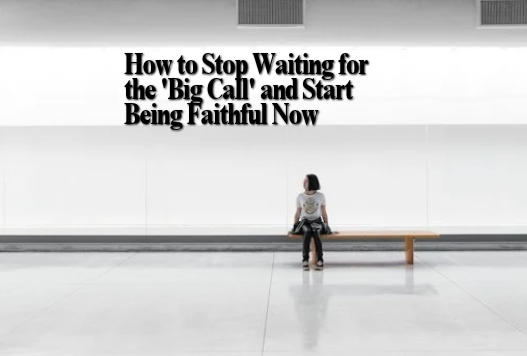
You are waiting for a sign. A clear word, a dramatic moment, a door that swings open with a light behind it. You have prayed about your calling for years. You have taken the assessments, read the books, listened to the sermons, and asked wise people what they see in you.
And you are still waiting. Meanwhile, the days keep passing. You tell yourself that once you know, you will go all in. Once the path is clear, you will commit. But the clarity does not come, and a quiet worry grows: What if I miss it? What if I am wasting the years God gave me?
The Waiting That Looks Like Faith but Feels Like Paralysis
If that is where you are, you are not alone.
You may be one of the most sincere people in your church. You do not want to run ahead of God, and you do not want to settle for less than He has for you. So you wait, carefully and prayerfully. And that sincerity is real.
But somewhere along the line, waiting for the call became a way of living. You hold back effort in the present because it might not be “the thing.” You hesitate to commit to a project, a ministry, a skill, or a relationship because it might not be the main assignment. And a low-grade anxiety follows you around, a feeling of being on the edge of your life instead of inside it.
Here is what I need you to hear: God is far less interested in revealing your entire calling than in guiding your obedience today. And the clearest path toward your calling usually runs straight through your current faithfulness.
Let’s walk through this together. We will name the trap, see what the Bible actually shows about how God calls people, and take eight practical steps to trade future-focused anxiety for present-day obedience.
Name the Problem: You Are Treating Calling as an Event Instead of a Path
Let me say it plainly. Many of us imagine calling as a single, dramatic moment, a burning bush, a voice from heaven, a clear job description. And while God does sometimes speak that way, it is rare. For most people, calling unfolds slowly, through a series of small steps taken in obedience.
When you treat calling as an event, you make the present a waiting room. You do not invest in what is in front of you, because it does not feel like the big thing. And you miss the training, the character, and the relationships God is building in you through the very things you consider insignificant.
The truth is that your current faithfulness is not separate from your calling. It is your calling, at this stage.
Why This Is So Common (and So Damaging)
The psychological layer. Uncertainty is uncomfortable, and a single dramatic answer promises relief. If you could just know, you could stop wrestling with the question. So you search for certainty before you act, even though certainty rarely comes in advance.
Psychologists call this “analysis paralysis,” the tendency to over-evaluate options to avoid the risk of choosing wrongly. It feels responsible, but it can freeze you for years.
Our culture also tells us that meaningful lives are visible and extraordinary. We hear stories of dramatic callings, and we forget that these stories are the highlights, not the full account of what preceded them.
The spiritual layer. The enemy loves to keep you looking over the horizon. If you are consumed with finding the “big call,” you may neglect the ordinary obedience God has already asked of you. A person who is always waiting for tomorrow’s assignment rarely does today’s well.
And here is the quiet cost: when you refuse to be faithful in small things, you lose the very preparation that bigger things require. Jesus said it plainly:
“Whoever can be trusted with very little can also be trusted with much, and whoever is dishonest with very little will also be dishonest with much.” (Luke 16:10)
The way to be trusted with more is to be faithful with what you have. That is not a delay of the calling. That is the process of it.
Biblical Reframing: God Calls People Who Are Already Being Faithful
Look at how God actually called the people in the Bible. Almost none of them were sitting idle, waiting for a sign.
When Samuel went looking for the next king of Israel, Jesse paraded his sons in front of him. None of them was chosen. Then Samuel asked:
“So he asked Jesse, ‘Are these all the sons you have?’ ‘There is still the youngest,’ Jesse answered. ‘He is tending the sheep.'” (1 Samuel 16:11)
David was in the field, doing his job. Nobody was watching. And later, when he stood before Goliath, he explained where his courage came from:
“Your servant has been keeping his father’s sheep. When a lion or a bear came and carried off a sheep from the flock, I went after it, struck it and rescued the sheep from its mouth.” (1 Samuel 17:34-35)
His private faithfulness prepared him for his public moment. The lion and the bear came before Goliath.
Moses was not planning a dramatic rescue when God called him. He was doing something quite ordinary:
“Now Moses was tending the flock of Jethro his father-in-law, the priest of Midian, and he led the flock to the far side of the wilderness and came to Horeb, the mountain of God.” (Exodus 3:1)
Forty years in the wilderness, tending sheep. Forty years of what must have felt like wasted time. Yet it was the preparation for everything.
And here is a sentence worth underlining about David’s life:
“Now when David had served God’s purpose in his own generation, he fell asleep.” (Acts 13:36)
David served God’s purpose in his own generation. Not in someone else’s. Not in a future one. His calling was lived in the time and place he was given.
Paul gives practical guidance to people wondering where they fit:
“Nevertheless, each person should live as a believer in whatever situation the Lord has assigned to them, just as God has called them.” (1 Corinthians 7:17)
Whatever situation the Lord has assigned to them. Your current situation is not an accident. It is an assignment.
And Jesus described what He looks for at the end of the road:
“His master replied, ‘Well done, good and faithful servant! You have been faithful with a few things; I will put you in charge of many things. Come and share your master’s happiness!'” (Matthew 25:21)
Faithful with a few things. The doorway to “many things” is faithfulness with the few.
What Present-Day Faithfulness Actually Looks Like
It may help to picture it. Imagine a woman who feels called to help hurting people but is waiting for the “right” ministry to open. In the meantime, she checks in on a lonely neighbor, listens well at work, and prays for her friends by name. Five years later, those small acts have taught her how to care, shown her where the needs are, and built the trust that makes a larger ministry possible. She never received a dramatic sign. She simply kept saying yes to what was in front of her.
That is how most callings are discovered: not in a flash, but in the faithful repetition of ordinary obedience. Direction tends to become clearer when you are moving, not when you are standing still.
Eight Practical Steps to Stop Waiting and Start Being Faithful
Here is how to move from waiting for the call to walking in it.
1. Name What You Have Been Waiting For
You cannot challenge an expectation you have not identified.
Practical action: Finish this sentence honestly: “I am waiting for God to show me ____ before I fully commit to ____.” Write it out. Then ask: Has God asked me to wait for that, or have I assumed I should?
2. Examine What You Believe a “Calling” Is
Your picture of calling shapes how you respond to it.
Practical action: Write down what you imagine a calling looks like. Is it a job? A platform? A ministry title? A feeling? Then compare it to the lives of David, Moses, and Ruth. Notice how much of their calling was ordinary work, done faithfully, before anything dramatic happened.
3. Ask What God Has Already Asked of You
Before searching for new direction, look at the instructions you have already received.
“Trust in the Lord and do good; dwell in the land and enjoy safe pasture.” (Psalm 37:3)
Do good. Dwell in the land. The instructions here are present-tense and simple.
Practical action: List every clear instruction from Scripture or from God’s guidance in your life that you have not fully obeyed. Examples might include forgiving someone, serving at church, caring for a family member, finishing a project, or being generous. Choose one and begin there.
4. Map Your Current Assignments
Your current life contains more of your calling than you think.
Practical action: Draw a simple list of the people, responsibilities, and opportunities currently in your care. Ask God, “What does faithfulness look like in each of these?” Write one concrete action for each. This is your present-day calling.
5. Practice One Small Act of Faithfulness Daily
The way to be faithful in much is to be faithful in little, consistently.
Practical action: Each morning, ask, “Lord, what is today’s assignment?” Then choose one small thing, a phone call, a task, a word of encouragement, a deadline met, and do it with care. Check it off at day’s end. Let faithfulness become a habit.
6. Cultivate Private Faithfulness
David’s lion and bear came when no one was looking. Your private choices are your training ground.
Practical action: Identify one area where you are faithful only when you are seen, such as prayer, honesty, work ethic, or integrity. Commit to practicing it where no one will notice. Let your private life become the foundation for your public one.
7. Stop Rehearsing the Future
Spending your energy imagining a future role pulls you out of the life in front of you.
“All hard work brings a profit, but mere talk leads only to poverty.” (Proverbs 14:23)
Practical action: The next time you catch yourself daydreaming about your “real” calling, redirect your attention to a task you can do now. Say, “Lord, I trust You with the future. Show me what to do next.” Then do it.
8. Review Weekly and Release the Rest
Faithfulness grows when you reflect on it. And peace grows when you release the outcome.
Practical action: Once a week, spend ten minutes asking: Where was I faithful? Where did I hold back? What is one step for next week? Then pray, “Lord, I’ll do my part. You hold the plan.” Write down any pattern of direction you notice. Over time, you may see your calling taking shape in the very things you have been doing.
You Are Not Missing Your Calling
I want to leave you with something steady.
You are not behind. You are not about to miss your calling because you did not receive a dramatic sign. God knows where you are, and He is not hiding His will from you. He is leading you, one faithful step at a time, in the life you are already living.
Some of you will look back in ten years and see that the thing you now call “waiting” was actually the road. The skills you built, the character you formed, the people you served, all of it was pointing somewhere. And some of you will find that your calling was never one big thing, but a lifetime of faithful small things that added up to a life that mattered.
If this post challenged you, take one step this week. Name what you have been waiting for. Choose one act of faithfulness. Do it today.
And if you want help discerning what faithfulness looks like in your season, and sorting present obedience from future anxiety, I would love to walk with you. You were never meant to stand at the edge of your life.
Be faithful with what is in your hands today. The rest belongs to Him.