You see the announcement and you smile. You type the comment: So happy for you! You even mean it, mostly. Then you put the phone down, and something small and sour settles in your stomach.
It was her promotion. His book deal. Their new house, their perfect family photo, their ministry that seems to be growing while yours sits still. You are not wishing them harm. You are genuinely glad for them. But you are also quietly measuring yourself against them, and you are coming up short. By the end of the day you feel a little smaller than you did that morning.
The Smile That Doesn’t Match the Ache
If that scene is familiar, you are not alone.
Comparison is rarely dramatic. It does not announce itself as envy or bitterness. It shows up as a flicker of discouragement, a sudden loss of motivation, a thought like Why can’t that be me? or What am I even doing with my life? And then it passes, and you carry on, and it returns the next time you scroll.
You may be ashamed of it. As a believer, you know you are supposed to rejoice with others. You want to be the kind of person who celebrates easily. And yet your heart, left to itself, keeps doing math, measuring your worth by someone else’s wins.
Here is what I need you to hear: comparison is not a sign you are a bad person. It is a sign your eyes have drifted to the wrong place. And you can learn to celebrate others fully without shrinking yourself.
Let’s walk through this together. We will name what comparison is really doing, look at what Scripture says about envy and celebration, and take eight practical steps to move from measuring to rejoicing, while staying rooted in the life God gave you.
Name the Problem: You Are Using Someone Else’s Life as Your Measuring Stick
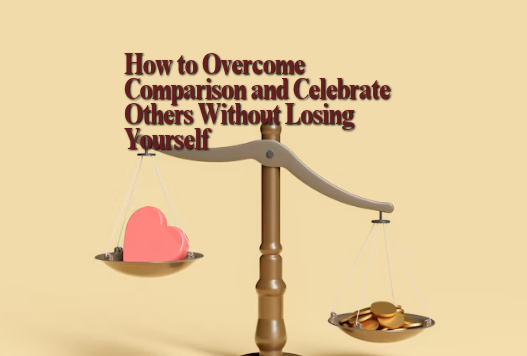
Let me say it plainly. Comparison happens when you take another person’s story, and usually just the visible, edited part of it, and use it to evaluate your own. The question underneath is always the same: Am I enough?
And here is the problem. It never gives you a satisfying answer. If you compare yourself to someone ahead of you, you feel behind. If you compare yourself to someone behind you, you feel proud, and then anxious about who might pass you. There is no stable ground in comparison. It keeps you either discouraged or defensive, and never at rest.
The deeper issue is not the other person’s success. It is that you have attached your sense of worth to a scoreboard that God never gave you.
Why This Is So Common (and So Damaging)
The psychological layer. Human beings are wired to evaluate ourselves relative to others. It is how we learn where we fit. In a small village, that wiring was manageable, because you compared yourself to a handful of people whose full lives you could see.
Now you compare yourself to thousands, and you see only the highlights. Their best moments, their best angles, their best news. Meanwhile you live inside your own behind-the-scenes. You are comparing your whole life to someone else’s trailer.
Comparison also quietly feeds on insecurity. The less certain you are about who you are, the more you look to others to tell you.
The spiritual layer. Scripture does not treat envy lightly. It tells us plainly:
“A heart at peace gives life to the body, but envy rots the bones.” (Proverbs 14:30)
Rots the bones. It is not a harmless feeling. It eats away at you from the inside. And James warns that it carries consequences far beyond your own heart:
“For where you have envy and selfish ambition, there you find disorder and every evil practice.” (James 3:16)
The very first story of envy in the Bible ends in murder. Cain looked at his brother Abel, saw that God had accepted Abel’s offering, and his heart turned:
“But on Cain and his offering he did not look with favor. So Cain was very angry, and his face was downcast.” (Genesis 4:5)
Pay attention to God’s response. He did not condemn Cain on the spot. He spoke to him with kindness:
“Then the Lord said to Cain, ‘Why are you angry? Why is your face downcast? If you do what is right, will you not be accepted?'” (Genesis 4:6-7)
God’s question was an invitation. You do not have to go this way. Look at your own life, and do what is right. Comparison never stays small if it is left unchecked. But God meets it early, with a question and a way out.
The damage is real. Comparison steals your joy. It poisons friendships because you cannot fully celebrate people you secretly resent. It distorts your calling, tempting you to copy someone else’s path instead of walking your own. And it makes you ungrateful for what God has actually given you.
Biblical Reframing: Different Lanes, One Body
Here is the shift that changes everything: God did not make you to compete with others. He made you to complete something with them.
Listen to how Paul describes the church:
“But in fact God has placed the parts in the body, every one of them, just as he wanted them to be.” (1 Corinthians 12:18)
Just as he wanted them to be. Your place was chosen. You are not a failed version of someone else. And Paul goes on:
“If one part suffers, every part suffers with it; if one part is honored, every part rejoices with it.” (1 Corinthians 12:26)
When another part of the body is honored, it is not a loss for you. It is a win for the whole. The eye does not envy the hand. They belong to the same body.
Look at what Jesus said to Peter. After Jesus told Peter how his life would end, Peter glanced over at John and asked:
“When Peter saw him, he asked, ‘Lord, what about him?’ Jesus answered, ‘If I want him to remain alive until I return, what is that to you? You must follow me.'” (John 21:21-22)
What is that to you? You must follow me. It is one of the most freeing sentences in the Bible. Your assignment is yours. Their path is theirs. And Jesus is calling you, by name, to yours.
Then consider two very different responses to someone else’s success. Saul heard the women singing about David’s victories, and it destroyed him:
“From that time on Saul kept a close eye on David.” (1 Samuel 18:9)
But Jonathan, who as the king’s son had every reason to be threatened, responded in the opposite way:
“Jonathan became one in spirit with David, and he loved him as himself.” (1 Samuel 18:1)
“Jonathan took off the robe he was wearing and gave it to David, along with his tunic, and even his sword, his bow and his belt.” (1 Samuel 18:4)
Jonathan was secure enough to celebrate the one who would take the throne he might have inherited. He could do that because his identity did not depend on the crown.
That is the secret. Celebrating others becomes possible when you are secure in who you are. And Paul gives the command plainly:
“Rejoice with those who rejoice; mourn with those who mourn.” (Romans 12:15)
Eight Practical Steps to Overcome Comparison and Celebrate Others
Here is how to move from measuring to rejoicing, without losing yourself.
1. Notice the Trigger Without Judging Yourself
You cannot address what you do not see. Begin by simply noticing when comparison shows up.
Practical action: For one week, keep a note on your phone. Each time you feel that small sinking feeling, write down who or what triggered it, such as a post, a conversation, a success story. Do not criticize yourself. Just gather the data. Patterns will appear.
2. Name It Honestly to God
Envy loses power when it is exposed. Hiding it keeps it alive.
“Then the Lord said to Cain, ‘Why are you angry? Why is your face downcast?'” (Genesis 4:6)
God asked the question so that Cain could answer honestly.
Practical action: Pray plainly: “Lord, I feel envious of ____. I feel behind. I don’t want this in my heart. Please meet me here.” No polishing. Let Him hear the real thing.
3. Ask What the Comparison Is Revealing
Often, envy is pointing to a longing. It is not always a sin to be dealt with. Sometimes it is information to be understood.
Practical action: Ask yourself, “What exactly do I want that they have?” Is it a sense of progress? Recognition? Security? Rest? Rather than coveting their life, take that desire to God and ask what He is inviting you into. Some longings are His way of showing you what to pursue in your own lane.
4. Return to Your Own Lane
John 21 is the ultimate lane-keeping verse. Your job is to follow Jesus, not to monitor everyone else’s route.
“Each one should test their own actions. Then they can take pride in themselves alone, without comparing themselves to someone else.” (Galatians 6:4)
Practical action: Write down three things God has clearly asked of you in this season. When comparison rises, say aloud, “What is that to me? I will follow You.” Then take one small step on one of those three things.
5. Remember You Belong to a Body
You are not in a race. You are part of something larger, where every member’s contribution matters.
Practical action: List the strengths, gifts, and experiences you bring that no one else has. Then list a few people whose gifts differ from yours and whom you genuinely benefit from. Say a prayer of thanks that God put them in the same body.
6. Practice Celebration Out Loud
Celebrating others is a skill. It strengthens with use, like any other muscle, even when your feelings lag behind your choice.
Practical action: This week, send a specific, sincere message of encouragement to one person whose success has stirred up comparison in you. Not “Congrats!” but “I loved how you handled ____. That took real courage.” Choosing to celebrate, even before you feel it, retrains your heart.
7. Pray a Blessing Over the Person
It is almost impossible to stay resentful toward someone you are sincerely praying for.
“Do nothing out of selfish ambition or vain conceit. Rather, in humility value others above yourselves, not looking to your own interests but each of you to the interests of the others.” (Philippians 2:3-4)
Practical action: Each day for a week, pray by name for the person you are comparing yourself to. Ask God to bless their work, protect their heart, and prosper what He has given them. Mean it as best you can. Ask Him to make it real when you cannot.
8. Build an Abundance Mindset
Comparison assumes that someone else’s gain is your loss. God’s economy does not work that way. In the parable of the workers in the vineyard, the landowner asks a pointed question of the resentful ones:
“Don’t I have the right to do what I want with my own money? Or are you envious because I am generous?” (Matthew 20:15)
God’s generosity toward others does not shrink His generosity toward you.
Practical action: Each night, write down three specific things God has done or given in your life that day. Keep the list. Over time, you will begin to see your own life as full, not lacking, and others’ blessings will feel less like threats.
You Are Exactly Where He Placed You
I want to leave you with something firm.
You are not behind. You are not lesser. You are a deliberate part of God’s design, with a lane and a purpose that no one else can fill. When you stop measuring yourself by other people’s lives, you are free to receive your own, and to cheer for theirs with a whole heart.
The goal is not to feel nothing when others succeed. It is to bring what you feel honestly to God, let Him settle it, and choose celebration anyway. Over time, the celebrating gets easier. The envy loses its grip. And you begin to experience something rare: the joy of being truly glad for someone else, without losing a thing.
If this post named something you have been carrying, take one step this week. Send the message. Pray the blessing. Say the sentence: “What is that to me? I will follow You.”
And if you want help finding your own lane and learning to walk in it with confidence, I would love to walk with you. You were never meant to live by someone else’s scoreboard.
Look to Him. Run your race. And cheer for the people running beside you.