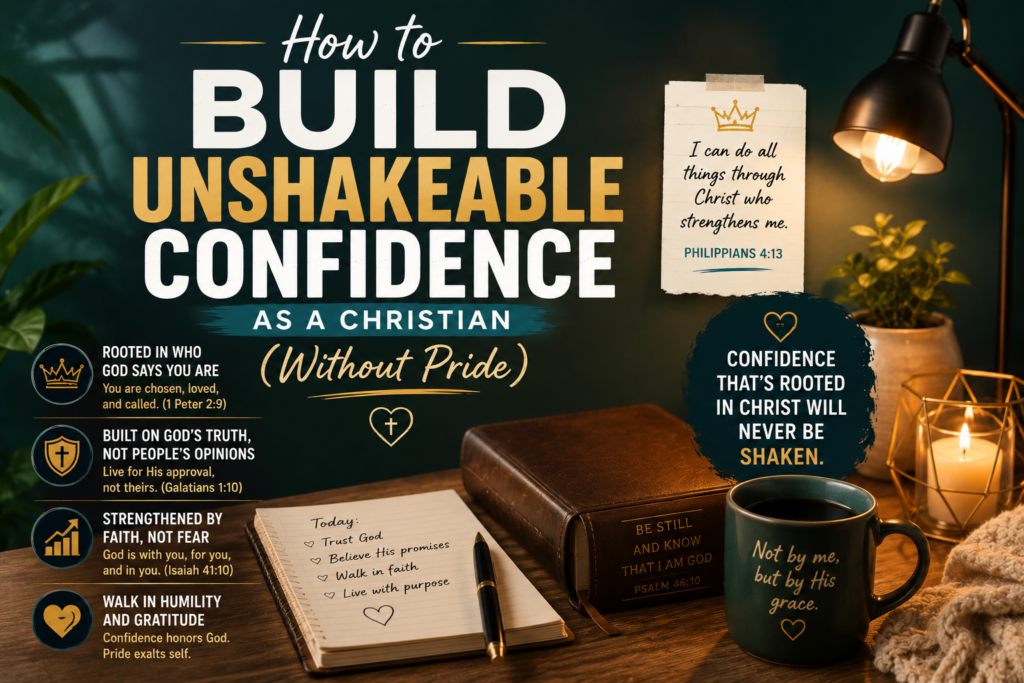
There’s a tension many Christians quietly wrestle with.
You know you’re called to step up, speak out, lead, create, or pursue something significant. But every time you begin to move with confidence, a familiar unease creeps in: Is this pride? Am I thinking too highly of myself? Shouldn’t I just stay humble and small?
So you shrink. You deflect compliments. You downplay your gifts. You hesitate when you should move. And you call it humility — when really, it might be fear wearing humility’s clothes.
Here’s the truth: false humility is not the same as godly humility. And confidence rooted in Christ is not the same as pride.
The world swings between two broken extremes — arrogant self-confidence on one end, crippling self-doubt on the other. But Scripture offers a third way: a deep, stable, Spirit-rooted confidence that has nothing to do with how impressive you are and everything to do with how faithful God is.
That’s the confidence this post is about. And it’s available to you — right now, exactly as you are.
The Problem With How We’ve Defined Confidence
Most of the confidence the world sells is built on shifting sand: your performance, your appearance, your achievements, your social approval, your track record of success.
That kind of confidence feels great — until you fail, until someone criticizes you, until circumstances change. Then it collapses, because it was never built on anything stable in the first place.
Many Christians, sensing that this kind of self-confidence is hollow, overcorrect — swinging into self-deprecation and smallness that they mistake for spiritual virtue.
But consider this: Moses initially shrank from his calling (Exodus 3-4). Gideon called himself the least of his family (Judges 6:15). Jeremiah said he was too young (Jeremiah 1:6). In every case, God’s response wasn’t to validate their smallness — it was to redirect their gaze from themselves to Him.
The issue was never “you’re too confident.” It was “you’re looking in the wrong place for your confidence.”
What Does the Bible Say About Confidence?
Far from discouraging confidence, Scripture is filled with bold, courageous, faith-fueled people who moved with extraordinary certainty — not because of who they were, but because of who God is.
“I can do all this through him who gives me strength.” — Philippians 4:13
“The Lord is my light and my salvation — whom shall I fear? The Lord is the stronghold of my life — of whom shall I be afraid?” — Psalm 27:1
“For the Spirit God gave us does not make us timid, but gives us power, love and self-discipline.” — 2 Timothy 1:7
“Let us then approach God’s throne of grace with confidence, so that we may receive mercy and find grace to help us in our time of need.” — Hebrews 4:16
Timidity is not a fruit of the Spirit. Shrinking back from your calling is not a sign of humility. And playing small is not the same as being servant-hearted.
God explicitly gave you a spirit of power — not timidity. Biblical confidence isn’t arrogance. It’s the natural result of knowing who you are in Christ and who Christ is in you.
The Difference Between Biblical Confidence and Pride
Understanding this distinction frees you from the false choice between confidence and humility.
Pride says: “Look at me. I am impressive. I don’t need God or anyone else.”
Biblical confidence says: “Look at what God has done in and through me. Apart from Him I can do nothing — but with Him, nothing is impossible.”
“But by the grace of God I am what I am, and his grace to me was not without effect.” — 1 Corinthians 15:10
“Not that we are competent in ourselves to claim anything for ourselves, but our competence comes from God.” — 2 Corinthians 3:5
Pride takes credit. Biblical confidence gives it. Pride is self-sourced. Biblical confidence is God-sourced. Pride is fragile — it collapses when performance fails. Biblical confidence is unshakeable — because its foundation never changes.
The person walking in biblical confidence isn’t thinking less of themselves. They’re thinking of themselves less — because their gaze is fixed on God, not on their own impressiveness or inadequacy.
“Humility is not thinking less of yourself, it’s thinking of yourself less.” — C.S. Lewis
7 Ways to Build Unshakeable Biblical Confidence
1. Anchor Your Identity in Christ — Not in Performance
The most foundational shift you can make is moving your sense of self from what you do to who you are in Christ.
Performance-based identity is inherently unstable. It rises and falls with your results, your reputation, and other people’s opinions. Christ-based identity is fixed — sealed by the Holy Spirit, grounded in grace, and completely immune to your worst day.
“Yet to all who did receive him, to those who believed in his name, he gave the right to become children of God.” — John 1:12
“And you also were included in Christ when you heard the message of truth… marked in him with a seal, the promised Holy Spirit.” — Ephesians 1:13
You are a child of God. You are sealed. You are chosen. That identity doesn’t change when you fail, when you’re criticized, or when your circumstances shift. Build your confidence on that — and watch how differently you move through the world.
Practical action: Write out 5 statements of who you are in Christ — not what you do or have accomplished, but who Scripture says you are. Read them every morning this week before you engage with anything else.
2. Stop Comparing Yourself to Others
Comparison is one of the fastest ways to erode confidence — in both directions. When you compare yourself to someone who seems further ahead, you feel inadequate. When you compare yourself to someone further behind, you slip into subtle pride. Either way, comparison pulls your eyes off God and onto a measuring stick He never gave you.
“We do not dare to classify or compare ourselves with some who commend themselves. When they measure themselves by themselves and compare themselves with themselves, they are not wise.” — 2 Corinthians 10:12
“Each one should test their own actions. Then they can take pride in themselves alone, without comparing themselves to someone else.” — Galatians 6:4
God didn’t call you to run someone else’s race. He called you to run yours — with the gifts, the story, the season, and the calling He specifically gave you.
Practical action: Every time you notice a comparison thought arising, redirect it with this question: “What has God specifically called and gifted ME to do?” Bring your eyes back to your own lane.
3. Rehearse God’s Faithfulness Not Your Failures
Confidence grows through remembered evidence. When you consistently rehearse your failures, your insecurities, and your limitations, your confidence shrinks. When you consistently rehearse God’s faithfulness — the ways He has come through, provided, guided, and sustained you — your confidence expands.
“I will remember the deeds of the Lord; yes, I will remember your miracles of long ago.” — Psalm 77:11
David repeatedly rehearsed God’s faithfulness in his psalms — not to be sentimental, but as a strategic act of faith. He reminded himself of what God had done so that he could trust what God would do.
The same God who parted the Red Sea, who shut the lions’ mouths, who raised the dead — that God is your God. Remembering that is not arrogance. It’s wisdom.
Practical action: Start a “faithfulness journal” — a running record of specific ways God has come through for you. When confidence wavers, read it. Remembered faithfulness is one of the most powerful confidence-builders available to you.
4. Act Before You Feel Ready
Confidence is rarely a prerequisite for action — it’s usually a result of it. Most people wait to feel confident before they step out. But biblically, the pattern is almost always reversed: you step out in obedience, and confidence builds through the experience of God showing up.
“Have I not commanded you? Be strong and courageous. Do not be afraid; do not be discouraged, for the Lord your God will be with you wherever you go.” — Joshua 1:9
God didn’t tell Joshua to wait until he felt strong. He commanded him to be strong — and the assurance of God’s presence was the basis for that command, not Joshua’s emotional state.
You don’t have to feel confident to act confidently. You have to know that God goes before you — and then move.
Practical action: Identify one thing you’ve been postponing because you don’t feel ready or confident enough. Take one concrete step toward it this week — not because the fear is gone, but because God is with you regardless of the fear.
5. Renew Your Mind Daily in God’s Truth
What you consistently think about yourself becomes what you believe about yourself. And what you believe shapes how you live. If your inner narrative is dominated by self-doubt, unworthiness, and limitation — your confidence will reflect that, no matter how many motivational posts you consume.
The antidote is daily, intentional mind renewal.
“Do not conform to the pattern of this world, but be transformed by the renewing of your mind.” — Romans 12:2
“We take captive every thought to make it obedient to Christ.” — 2 Corinthians 10:5
Every self-limiting thought that contradicts God’s Word about you needs to be captured, examined, and replaced with truth. This is not a one-time exercise — it’s a daily discipline that compounds over time into a genuinely transformed mindset.
Practical action: Identify your top 3 self-limiting beliefs about yourself. Find a scripture that directly counters each one. Write them on notecards. Speak them out loud every morning for 30 days. Watch what shifts.
6. Use Your Gifts — Consistently and Without Apology
One of the most practical ways to build confidence is to simply use what God has given you — regularly, faithfully, and without constantly apologizing for it.
“Do not neglect your gift.” — 1 Timothy 4:14
“Each of you should use whatever gift you have received to serve others.” — 1 Peter 4:10
Gifts exercised grow. Gifts withheld atrophy. Every time you use your God-given abilities to serve, create, lead, or contribute — and do it without shrinking or self-sabotaging — your confidence in those gifts deepens.
You were not given gifts to hide. You were given them to deploy — for God’s glory and others’ benefit. Using them boldly is not pride. It is stewardship.
Practical action: This week, find one opportunity to use one of your primary gifts in service to someone else. Do it without minimizing it, deflecting the outcome, or apologizing for it. Offer it fully — and notice what God does with it.
7. Embrace the Process — Confidence Is Built, Not Downloaded
Finally, understand that genuine, unshakeable confidence is not an overnight transformation. It is built — layer by layer, step by step, through repeated encounters with God’s faithfulness, repeated acts of obedience, and the gradual replacement of lies with truth.
“Being confident of this, that he who began a good work in you will carry it on to completion until the day of Christ Jesus.” — Philippians 1:6
God is committed to your completion. He is not frustrated with your current level of confidence. He is patiently, purposefully building it — through every challenge you face, every step you take in faith, and every moment you choose truth over the lie that you’re not enough.
Give yourself grace in the process. Show up. Keep going. The confidence you’re building is not in yourself — it’s in a God who never fails.
Practical action: Write this on a notecard and put it somewhere visible: “I am not confident because of who I am. I am confident because of who God is — and He is always faithful.”
Godly Confidence Looks Like This
A person walking in biblical confidence:
- Speaks up when God prompts — without needing everyone’s approval first
- Uses their gifts fully — without minimizing or constantly apologizing
- Makes decisions from faith — not from fear of getting it wrong
- Receives criticism without being destroyed by it — because their identity isn’t in the opinion
- Acknowledges weakness openly — because they know God’s strength shows up there
- Gives credit to God freely — because they know where their ability comes from
- Steps into new territory — not because they have all the answers, but because God goes before them
That’s not arrogance. That’s a person who knows who they are in Christ — and has stopped letting fear, comparison, or past failure write the story of what they’re capable of.
You Were Not Made to Live Small
God did not save you, seal you, gift you, and call you — so that you could spend your life shrinking.
The world needs what God has placed in you. The people around you need the gifts, the wisdom, the voice, and the presence you carry. And a life lived in fearful smallness, calling itself humility, doesn’t serve anyone — least of all the God who designed you for more.
You were made to walk in the kind of confidence that makes people ask: “Where does that come from?” And the answer is the same every time: not from talent, not from track record, not from perfect circumstances — but from a deep, daily, unshakeable rootedness in the God who called you, equipped you, and goes before you.
If you’re ready to break free from the false humility, the comparison trap, and the self-doubt that has been keeping you small — and build the kind of Christ-rooted confidence that transforms every area of your life — Christian mindset coaching is designed to walk you through exactly that.
[Book your free discovery call today] — and let’s build a confidence that doesn’t depend on your performance, your past, or other people’s opinions.