You’ve prayed about it. You’ve journaled about it. You’ve talked to your friends about it. You’ve made a pros and cons list — maybe two or three. You’ve Googled it. You’ve slept on it.
And you’re still going in circles.
Overthinking is exhausting. It masquerades as wisdom and thoroughness, but underneath it’s usually something else entirely — fear, a need for control, or a difficulty trusting that God really has it handled.
If your mind rarely rests, if you replay conversations long after they’re over, if you can’t make a decision without spiraling through every possible outcome first — this post is for you.
The good news? God’s Word doesn’t just diagnose overthinking. It gives us a clear, practical path out of it.
Why We Overthink — The Root Beneath the Habit
Before we talk about how to stop overthinking, it helps to understand what’s actually driving it. Overthinking rarely exists on its own. It’s usually a symptom of something deeper:
Fear — of making the wrong choice, of failure, of what others think
Distrust — not fully believing God will catch you if you step out
Control — trying to think your way to certainty in a world that doesn’t offer it
Past wounds — times when things went wrong that now make your mind work overtime to “protect” you
Recognizing your root is important because it shapes how you address it. Telling an overthinker to “just stop” is like telling someone with a broken leg to “just walk.” The behavior is a signal — pointing to a belief that needs to be renewed.
What God Says About an Overactive Mind
Scripture doesn’t shy away from the reality of anxious, racing minds. It speaks directly to it — with both compassion and clear direction.
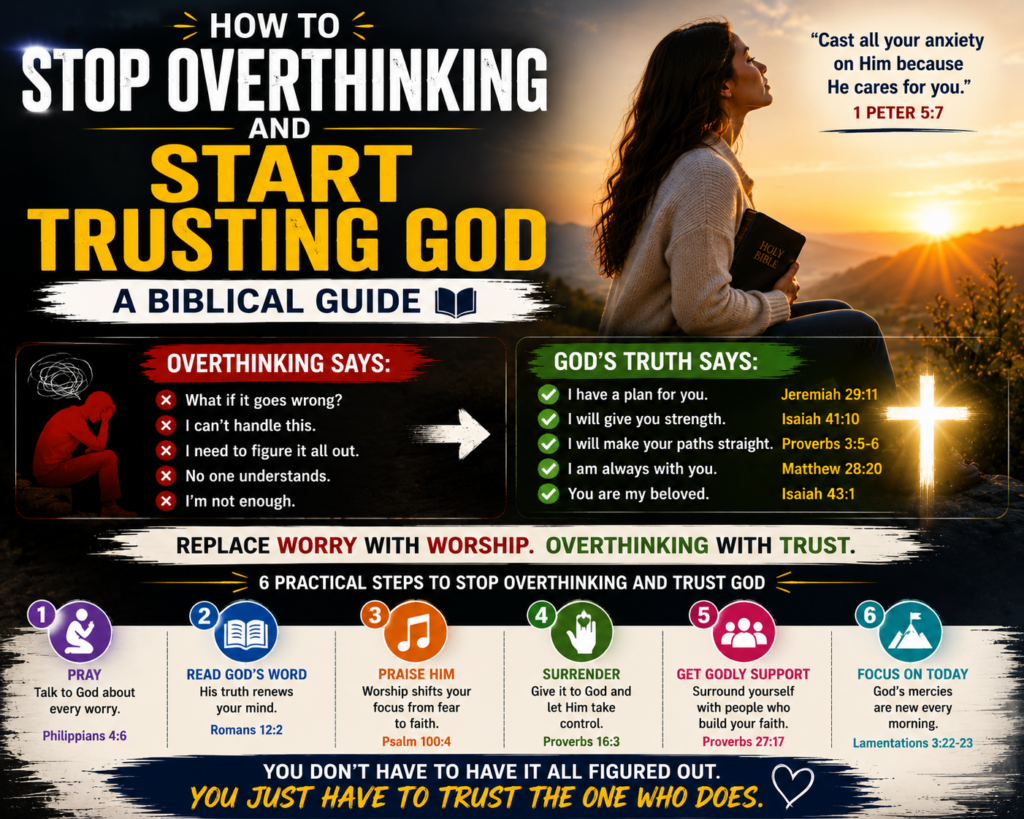
“Do not be anxious about anything, but in every situation, by prayer and petition, with thanksgiving, present your requests to God. And the peace of God, which transcends all understanding, will guard your hearts and your minds in Christ Jesus.” — Philippians 4:6-7
Notice what Paul offers in place of anxiety: not certainty, not all the answers, not a perfectly resolved situation — but peace that transcends understanding. Peace that makes no logical sense given the circumstances. Peace that guards — like a sentinel — the very mind that keeps running away from you.
“You will keep in perfect peace those whose minds are steadfast, because they trust in you.” — Isaiah 26:3
The connection is clear: a steadfast mind, fixed on God rather than on the problem, produces peace. Overthinking keeps the mind fixed on the problem. Trust fixes the mind on God.
7 Biblical Strategies to Stop Overthinking and Start Trusting God
1. Name What You’re Actually Afraid Of
Overthinking is almost always fear in disguise. The loop of “what if” scenarios isn’t really about thinking — it’s about feeling unsafe and trying to think your way to safety.Before you can break the cycle, name the fear underneath it.Ask yourself: What am I actually afraid will happen if I stop thinking about this and just trust God?Write it down. Bring it into the light. Unnamed fears have enormous power. Named fears can be handed to God.”Cast all your anxiety on him because he cares for you.” — 1 Peter 5:7You can’t cast what you won’t acknowledge. Name it, then release it.Action step: Journal for 5 minutes: “The thing I’m most afraid of in this situation is ___.” Then write a prayer releasing that specific fear to Go
2. Set a “Thinking Deadline”
Not every decision needs unlimited mental bandwidth. One practical tool to interrupt overthinking is giving yourself a defined window to think, weigh, and seek God — and then committing to move forward.
This isn’t rushing God. It’s refusing to let open-ended rumination become a substitute for trust.
“Commit to the Lord whatever you do, and he will establish your plans.” — Proverbs 16:3
The word “commit” here literally means to roll something onto someone else — like rolling a heavy burden off your shoulders onto God’s. At some point, you commit the decision to Him and move.
Action step: For your current overthought situation, set a decision date. Between now and then, pray, seek counsel, and gather what you need. On that date, make the best decision you can — and trust God with the rest.
3. Replace the Loop With Scripture — Out Loud
When the mental loop starts, your brain needs something stronger than willpower to interrupt it. That something is the living Word of God, spoken out loud.
“The word of God is alive and active. Sharper than any double-edged sword.” — Hebrews 4:12
When an overthinking spiral starts, speaking Scripture out loud engages your mind actively with truth — instead of letting it passively spin in fear. It’s not a magic formula. It’s a weapon.
Keep 2-3 scriptures ready that speak directly to trust and peace. When the loop begins, speak them. Repeat them. Let your mind chew on truth instead of anxiety.
Suggested anchors:
Proverbs 3:5-6
Isaiah 26:3
Philippians 4:6-7
Psalm 46:10
Action step: Choose one of the above scriptures. Write it on a notecard. The next time an overthinking spiral starts, stop — and speak that verse out loud three times before continuing.
4. Move Your Body to Break the Mental Cycle
This is practical, but it’s backed by both science and spiritual wisdom. When you’re trapped in a mental loop, your body is often still — and stillness can feed the spiral.
Movement interrupts the neurological pattern of overthinking. A walk, a workout, even washing the dishes can shift your brain out of rumination mode and create mental space for clarity.
Elijah, in his most overwhelmed moment in 1 Kings 19, wasn’t given a five-step strategy by God. He was told to eat, rest, and walk. God met him in the physical, embodied practice of caring for himself.
“Get up and eat, for the journey is too much for you.” — 1 Kings 19:7
Sometimes the most spiritual thing you can do is take a walk and trust that God is still working while you do.
Action step: When you feel an overthinking spiral coming on, stand up. Go outside if you can. Walk for 10-15 minutes while speaking a simple prayer: “God, I trust You with this. I’m releasing it to You right now.”
5. Practice Gratitude as an Interruption
Gratitude and anxiety cannot fully occupy the mind at the same time. This is why Paul pairs thanksgiving with the antidote to anxiety in Philippians 4:6 — it’s not an add-on. It’s part of the strategy.”…with thanksgiving, present your requests to God.” — Philippians 4:6When your mind is cataloguing everything that could go wrong, a deliberate practice of naming what is already right forces a reorientation — from what you fear losing to what God has already provided.This isn’t toxic positivity. It’s spiritual discipline. It trains your mind to see God’s faithfulness in the present even when the future feels uncertain.Action step: In the middle of your next overthinking spiral, stop and write down 5 specific things you’re grateful for right now — not generic blessings, but specific ones from the last 24 hours. Notice what shifts.
6. Talk to God More Than You Talk to Yourself
Here’s a pattern worth examining: when overthinking strikes, where does the conversation happen? Usually entirely inside your own head — with yourself, going in circles.
What if instead of thinking at the problem, you talked to God about it?
“Call to me and I will answer you and tell you great and unsearchable things you do not know.” — Jeremiah 33:3
Prayer isn’t a last resort after you’ve exhausted your own thinking. It’s the first move. And it’s not just about asking for answers — it’s about shifting the conversation from your own limited perspective to communion with an all-knowing, all-present, infinitely wise God.
Action step: The next time you catch yourself overthinking, literally say out loud: “God, I’m bringing this to You instead of going in circles again.” Then pray — honestly, specifically, without filtering. Let Him into the loop.
7. Take One Small Step Forward in Faith
Sometimes the only way out of the overthinking spiral is through — one step at a time.
Overthinking often thrives in inaction. The longer you wait for perfect clarity before moving, the more mental space there is for the loop to run. Faith, by contrast, moves — even without complete certainty.
“Your word is a lamp for my feet, a light for my path.” — Psalm 119:105
Notice: a lamp for your feet — not a floodlight illuminating the entire road. God often gives just enough light for the next step, trusting you to trust Him with the ones after that.
Action step: Identify the smallest possible step forward in your current situation. Not the whole decision — just one step. Take it. And notice how clarity often follows action, rather than preceding it.
The Deeper Invitation Behind Overthinking
Here’s something worth sitting with: God isn’t frustrated with your overthinking mind. He understands it. He knows what drives it — the fear, the wounds, the desire to get it right.
But He does have an invitation for you beyond it.
The invitation isn’t to think less — it’s to trust more. To move the weight of the outcome from your shoulders to His. To let the peace that passes understanding become your actual lived experience, not just a verse you know.
“Trust in the Lord with all your heart and lean not on your own understanding; in all your ways submit to him, and he will make your paths straight.” — Proverbs 3:5-6
“With all your heart” leaves no room for a divided mind — half trusting God, half trying to think your way to safety. Full trust. Full surrender. Full peace.
That’s what’s available to you.
Transformation Starts With a Renewed Mind
Overthinking isn’t a personality trait you’re stuck with. It’s a pattern — and patterns can be changed through the intentional, Spirit-empowered process of renewing your mind.
If you’re ready to break free from the mental loops that are keeping you stuck, exhausted, and unable to move forward with confidence — Christian mindset coaching is designed to walk you through exactly that transformation.
You don’t have to figure this out alone. You don’t have to keep going in circles. There is a way forward — and it starts with one surrendered thought at a time.
[Book your free discovery call today] — and let’s trade the overthinking spiral for God-anchored peace and clarity together.