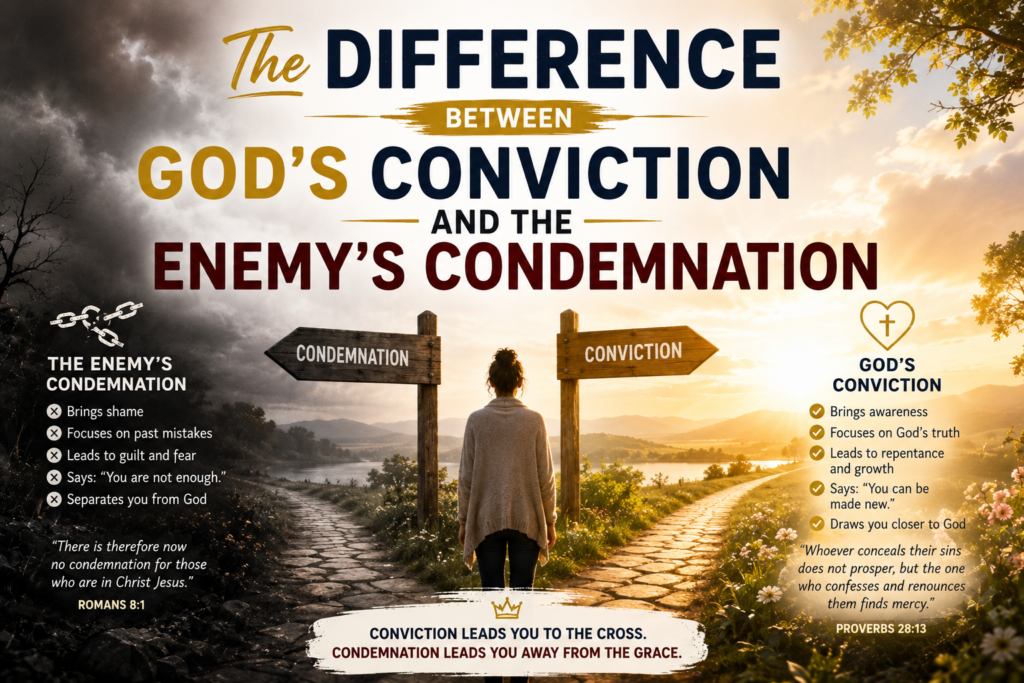
Have you ever done something wrong — or even just felt like you did — and then spent days, weeks, or even months drowning in guilt and shame?
You pray, but the weight doesn’t lift. You confess, but the feeling persists. You try to move forward, but something keeps pulling you back to the same moment, the same failure, the same voice saying: You’re a disappointment. You’ll never get it right. God must be so tired of you.
Here’s a question most Christians never think to ask in that moment: Is this God speaking — or is this the enemy?
Because they don’t feel the same. They don’t produce the same fruit. And confusing the two can keep you spiritually paralyzed for years — carrying a weight that was never meant for you to bear.
“Therefore, there is now no condemnation for those who are in Christ Jesus.” — Romans 8:1
God is not in the business of condemning His children. But He is absolutely in the business of convicting them — drawing them back to Himself through the gentle, purposeful work of the Holy Spirit.
Learning to tell the difference between the two is one of the most practically important skills in the Christian life. Let’s break it down.
What Is Conviction?
Conviction is the work of the Holy Spirit — a specific, purposeful, loving nudge that draws you toward repentance, restoration, and closer alignment with God.
“When he comes, he will prove the world to be in the wrong about sin and righteousness and judgment.” — John 16:8
Jesus described the Holy Spirit as our Counselor, our Helper, our Advocate. The Spirit’s role in conviction is not to crush you — it’s to correct you. Not to push you away from God, but to draw you back to Him.
Think of it like a loving parent who corrects a child not to humiliate them, but because they love them and want better for them. The correction stings — but it comes from love, it’s specific, and it leads somewhere good.
What Is Condemnation?
Condemnation, by contrast, is the enemy’s counterfeit of conviction. It uses guilt and shame not to restore you, but to destroy you — to keep you stuck, isolated, and convinced that you are too far gone for God’s grace.
“For the accuser of our brothers and sisters, who accuses them before our God day and night, has been hurled down.” — Revelation 12:10
Scripture calls Satan “the accuser.” Accusation is his primary strategy — and he is relentless at it. He doesn’t just point out what you did wrong. He uses it to make a sweeping judgment about who you are: Failure. Hypocrite. Unworthy. Unloved. Beyond repair.
Condemnation doesn’t lead anywhere good. It doesn’t produce repentance or restoration. It produces shame, self-punishment, spiritual paralysis, and distance from God — which is precisely what the enemy wants.
7 Key Differences Between Conviction and Condemnation
This is where it gets practical. When you’re in the middle of guilt and shame, here’s how to discern which voice you’re actually hearing.
1. Conviction Is Specific. Condemnation Is General.
Conviction points to a particular action, attitude, or pattern: “You spoke harshly to your spouse this morning. That was wrong. Go make it right.”
Condemnation makes sweeping character indictments: “You’re a terrible spouse. You always hurt the people you love. You’re never going to change.”
The Holy Spirit is a skilled surgeon — precise, targeted, purposeful. The enemy is a sledgehammer — broad, indiscriminate, aimed at your identity rather than your behavior.
“For the word of God is alive and active. Sharper than any double-edged sword, it penetrates even to dividing soul and spirit… it judges the thoughts and attitudes of the heart.” — Hebrews 4:12
Ask yourself: Is this voice pointing to something specific I need to address — or is it making a broad judgment about who I am as a person?
2. Conviction Leads Toward God. Condemnation Drives You Away.
Conviction — even when uncomfortable — produces a pull toward God. It makes you want to come to Him, confess, receive forgiveness, and restore the relationship.
Condemnation makes you want to hide from God. It produces the same response Adam and Eve had in the garden after the fall — shame that causes you to cover yourself and run in the opposite direction.
“Godly sorrow brings repentance that leads to salvation and leaves no regret, but worldly sorrow brings death.” — 2 Corinthians 7:10
Paul distinguishes between “godly sorrow” — which leads to repentance and life — and “worldly sorrow” — which leads to death. Conviction produces godly sorrow. Condemnation produces worldly sorrow.
Ask yourself: Does this feeling make me want to draw closer to God, or does it make me want to hide from Him?
3. Conviction Is Timely. Condemnation Is Repetitive.
Conviction addresses what needs to be addressed — and when you respond with genuine repentance, it lifts. God doesn’t keep bringing up what He has already forgiven.
“As far as the east is from the west, so far has he removed our transgressions from us.” — Psalm 103:12
“I, even I, am he who blots out your transgressions, for my own sake, and remembers your sins no more.” — Isaiah 43:25
Condemnation is relentless and repetitive. It replays the same failures on a loop — long after you’ve confessed, long after God has forgiven. It refuses to let you move forward. It keeps returning to the same wound, picking it open again and again.
If you’ve genuinely confessed something and the guilt keeps returning with the same intensity, that is not God reminding you of your sin. That is the enemy refusing to let you accept the grace God has already extended.
Ask yourself: Have I already confessed and repented of this? If yes — who is still bringing it up?
4. Conviction Addresses Behavior. Condemnation Attacks Identity.
Conviction says: “What you did was wrong.”
Condemnation says: “You are wrong. You are the problem. You are beyond help.”
This distinction is critical. God separates your behavior from your identity. Your sin is something you did — not something you are. In Christ, your identity remains secure even in your moments of failure.
“If we confess our sins, he is faithful and just and will forgive us our sins and purify us from all unrighteousness.” — 1 John 1:9
“Therefore, if anyone is in Christ, the new creation has come: The old has gone, the new is here!” — 2 Corinthians 5:17
The enemy wants to collapse the distinction between what you did and who you are — because if he can make you believe you are your failures, he can keep you from ever moving forward in freedom.
Ask yourself: Is this voice speaking about something I did — or making a verdict about who I am?
5. Conviction Produces Repentance and Peace. Condemnation Produces Shame and Paralysis.
Conviction — even when it produces initial sorrow — ultimately leads to a clear, productive outcome: repentance, restoration, and the peace that comes from being right with God again.
Condemnation leads nowhere productive. It keeps you spinning in shame without resolution — feeling terrible but not moving toward healing, change, or God.
“Repent, then, and turn to God, so that your sins may be wiped out, that times of refreshing may come from the Lord.” — Acts 3:19
Notice the outcome of genuine repentance: times of refreshing. Not more shame. Not extended punishment. Refreshing. Relief. Restoration.
If the guilt you’re experiencing isn’t leading you anywhere — if it’s just weight without direction — that’s a sign it may not be the Holy Spirit speaking.
Ask yourself: Is this feeling leading me somewhere productive — toward repentance and restoration — or is it just keeping me stuck in shame?
Conviction Sounds Like a Counselor. Condemnation Sounds Like an Accuser.
The Holy Spirit is described in Scripture as our Paraclete — our Counselor, Advocate, Helper, Comforter. Even in conviction, His tone carries the character of God: truth, yes — but also grace, love, and the desire for restoration.
The enemy is described as the accuser. His tone carries his character: harsh, merciless, relentless, designed to wound rather than restore.
“The Spirit you received does not make you slaves, so that you live in fear again; rather, the Spirit you received brought about your adoption to sonship. And by him we cry, ‘Abba, Father.'” — Romans 8:15
God’s Spirit doesn’t speak to you as a slave cowering before an angry master. He speaks to you as a child before a loving Father. The tone matters enormously.
Ask yourself: Does this voice sound like a loving Father who wants me to return to Him — or like a relentless accuser who wants me to stay broken?
Conviction Is Covered by Grace. Condemnation Ignores Grace.
Conviction always operates within the framework of God’s grace. It points to sin — but it simultaneously points to the cross, where that sin was already dealt with. It says “you were wrong” in the same breath as “and grace is available.”
Condemnation pretends grace doesn’t exist. Or it suggests that your particular sin is too serious, too repeated, or too shameful for grace to cover.
“But where sin increased, grace increased all the more.” — Romans 5:20
There is no sin — no failure, no repeated stumble, no shameful secret — that exceeds the reach of God’s grace. Condemnation wants you to believe otherwise. Grace tells the truth.
Ask yourself: Does this voice acknowledge the grace available to me — or does it suggest I’m beyond it?
What to Do When You’re Not Sure Which Voice You’re Hearing
Sometimes, in the fog of guilt and shame, it’s genuinely hard to tell. Here’s a practical framework for those moments:
- Bring it to God honestly.
Don’t run from the feeling. Bring it directly to God: “Lord, I’m feeling a lot of guilt right now. Is this You calling me to repentance — or is this the enemy condemning me? Help me discern.” - Check for specificity.
If the feeling is pointing to something specific you need to address, treat it as conviction. Repent, make it right where possible, receive forgiveness, and move forward. - Confess and receive — then release.
If you’ve already confessed and repented, receive God’s forgiveness by faith — even if the feeling hasn’t caught up yet. Declare: “I have confessed this. God has forgiven me. I receive that forgiveness now, and I refuse the enemy’s condemnation.” - Speak the Word out loud.
Romans 8:1 is one of the most powerful weapons against condemnation: “There is therefore now no condemnation for those who are in Christ Jesus.” Speak it. Repeat it. Let it become more real than the accuser’s voice. - Seek community and counsel.
Sometimes we need someone outside our own heads to help us discern clearly. A trusted pastor, mentor, or Christian mindset coach can provide the perspective and Spirit-led insight that shame and isolation make it hard to find on our own.
You Were Made to Live Free. Not Under Condemnation
God did not save you to keep you living under a cloud of perpetual guilt. He saved you to bring you into freedom — the radical, unearned, unshakeable freedom of a child who is fully known, fully forgiven, and fully loved.
“It is for freedom that Christ has set us free. Stand firm, then, and do not let yourselves be burdened again by a yoke of slavery.” — Galatians 5:1
The condemnation the enemy loads onto you is a yoke of slavery. You don’t have to wear it. You were not designed for it. And Christ already paid the price to remove it.
Learning to recognize the enemy’s voice — and refuse it — is not arrogance. It is your right as a child of God. It is walking in the freedom Jesus died to give you.
If you’ve been living under the weight of condemnation — carrying guilt that conviction alone doesn’t explain, shame that repentance hasn’t lifted — you may need more than information. You may need the kind of deep, guided, faith-rooted work that gets to the root of the shame and replaces it with the unshakeable truth of who God says you are.
That is exactly what Christian mindset coaching is designed to help you do.
[Book your free discovery call today] — and let’s replace the accuser’s voice with the truth that sets you free.