There’s a phrase you’ve probably heard in Christian circles: “Kingdom mindset.”
Maybe it’s been used in a sermon, a podcast, a book, or a coaching session. But if you’re honest, you might not be entirely sure what it actually means or what it looks like in the practical, ordinary moments of your daily life.
Is it about tithing more? Praying harder? Thinking positively? Going to church consistently?
It’s bigger than all of those things. And it’s more practical than it might sound.
A Kingdom mindset is not a spiritual personality type reserved for pastors, missionaries, and “super Christians.” It is a way of seeing a lens through which every area of your life, every decision you make, every relationship you invest in, and every resource you steward takes on eternal significance.
And it is available to every believer. Including you. Right now. Exactly where you are.
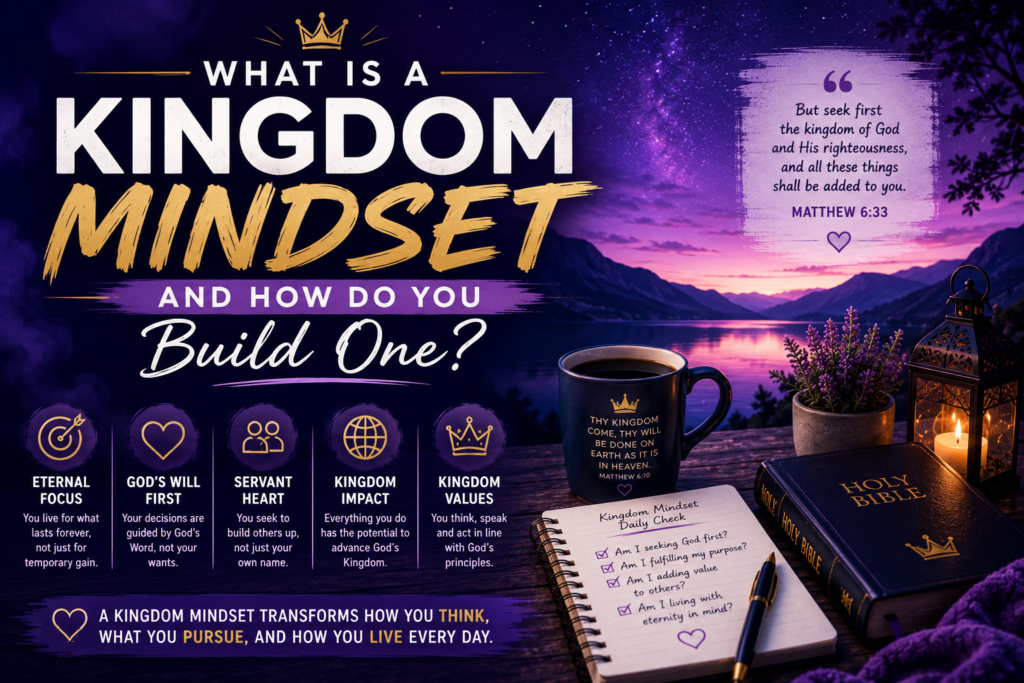
“But seek first his kingdom and his righteousness, and all these things will be given to you as well.” Matthew 6:33
Let’s break down what a Kingdom mindset actually is, why it changes everything, and how to build one practically and intentionally.
What Is the Kingdom of God?
Before we can understand a Kingdom mindset, we need to understand what the Kingdom actually is.
The Kingdom of God is not primarily a place it is a reign. It is the active, sovereign rule of God over all things over hearts, over history, over circumstances, over eternity. When Jesus launched His ministry, His first words were: “The Kingdom of God has come near. Repent and believe the good news.” (Mark 1:15)
The Kingdom is both here present in every believer through the Holy Spirit and not yet fully here, awaiting its complete fulfillment when Christ returns. Theologians call this the “already and not yet.”
What does this mean for your daily life? It means you are living in a Kingdom that is active, advancing, and eternal right now. Every choice you make, every word you speak, every relationship you invest in, every resource you steward either advances that Kingdom or doesn’t.
A Kingdom mindset sees life through that lens.
What Is a Kingdom Mindset?
A Kingdom mindset is a way of thinking, perceiving, and engaging with life that is aligned with God’s priorities, values, and eternal purposes rather than the world’s short-term, self-centered, scarcity-driven framework.
It is the practical outworking of Romans 12:2 in every dimension of life:
“Do not conform to the pattern of this world, but be transformed by the renewing of your mind. Then you will be able to test and approve what God’s will is his good, pleasing and perfect will.”
The “pattern of this world” is a mindset. And a Kingdom mindset is its Spirit-empowered alternative.
Where the world’s mindset says “What can I get?” a Kingdom mindset asks “What can I give?”
Where the world’s mindset says “Protect what’s yours” a Kingdom mindset says “Steward what’s God’s.”
Where the world’s mindset says “It’s all about now” a Kingdom mindset says “I’m building for eternity.”
Where the world’s mindset says “My success is measured by what I accumulate” a Kingdom mindset says “My success is measured by my faithfulness to what God entrusted me with.”
7 Characteristics of a Kingdom Mindset
1. Eternal Perspective Over Temporary Circumstance
A Kingdom mindset sees beyond the immediate. It holds current circumstances both good and painful in the context of eternity, where they take on a very different weight.
“For our light and momentary troubles are achieving for us an eternal glory that far outweighs them all. So we fix our eyes not on what is seen, but on what is unseen, since what is seen is temporary, but what is unseen is eternal.” 2 Corinthians 4:17-18
This doesn’t minimize real pain or real joy. It contextualizes both. The job loss, the diagnosis, the broken relationship, the unanswered prayer none of these are the final word. The final word belongs to the One whose Kingdom never ends.
In practice: When a difficult circumstance threatens to define your outlook, ask: “How does this look from an eternal perspective? What might God be doing in and through this that I can’t yet see?”
2. Stewardship Mindset Over Ownership Mindset
One of the most practically transformative shifts in Kingdom thinking is moving from an ownership mindset to a stewardship mindset.
An ownership mindset says: This is mine. I worked for it. I decide what to do with it.
A stewardship mindset says: This is God’s. He entrusted it to me. I manage it on His behalf.
“The earth is the Lord’s, and everything in it, the world, and all who live in it.” Psalm 24:1
“Moreover, it is required of stewards that they be found faithful.” 1 Corinthians 4:2
This applies to everything your money, your time, your talents, your relationships, your platform, your opportunities, your body. When you hold everything as a steward rather than an owner, anxiety about losing things decreases, generosity increases, and the question shifts from “What do I want to do with this?” to “What does God want me to do with this?”
In practice: Take one area of your life finances, time, or gifts and ask: “If I truly believed this belongs to God and I’m managing it for Him, what would I do differently?”
3. Abundance Thinking Over Scarcity Thinking
The world operates largely from a scarcity mindset the fear that there isn’t enough, that someone else’s gain is your loss, that you must hoard, compete, and protect your resources.
A Kingdom mindset operates from abundance not because it ignores reality, but because it recognizes the Source behind all resources.
“And my God will meet all your needs according to the riches of his glory in Christ Jesus.” Philippians 4:19
“Now to him who is able to do immeasurably more than all we ask or imagine, according to his power that is at work within us.” Ephesians 3:20
God is not running low on resources, opportunities, favor, or provision. He is immeasurably abundant. A Kingdom mindset trusts that generosity doesn’t deplete it activates. That celebrating others’ success doesn’t diminish yours. That God’s supply is not limited by earthly economics.
In practice: Where do you operate from scarcity? Identify one area money, time, opportunity, recognition and deliberately replace the scarcity thought with a Kingdom abundance truth from Scripture.
4. Serving Others Over Self-Advancement
The world’s definition of success is ascending climbing higher, gaining more, being seen, being first. The Kingdom’s definition of greatness is exactly the opposite.
“Instead, whoever wants to become great among you must be your servant, and whoever wants to be first must be your slave just as the Son of Man did not come to be served, but to serve, and to give his life as a ransom for many.” Matthew 20:26-28
Jesus the King of the Kingdom defined greatness as servanthood. The most Kingdom-minded person in the room is usually not the most prominent one. It’s the one washing the feet.
This doesn’t mean you don’t pursue excellence, leadership, or impact. It means the motivation shifts from self-promotion to contribution, from building your kingdom to building His.
In practice: Ask yourself honestly: “In my work, my relationships, my ministry am I primarily seeking to advance myself, or to serve others and honor God?” Let the answer guide your next decision.
5. Faithfulness Over Outcomes
A Kingdom mindset releases the grip on outcomes and places its weight on faithfulness. You control your obedience. God controls the results.
“His master replied, ‘Well done, good and faithful servant! You have been faithful with a few things; I will put you in charge of many things. Come and share your master’s happiness!'” Matthew 25:21
Notice what the master praises: not results, not scale, not impressive numbers. Faithfulness. The servant who took the five talents and doubled them received the same commendation as the one who took two and doubled those. The praise was for the doing the faithfulness not the outcome.
This reframes how you measure success. You are not responsible for the harvest. You are responsible for the planting, the watering, the tending faithfully, consistently, in the strength God provides.
In practice: Where have you been measuring your worth by outcomes rather than faithfulness? Identify one area and reframe your success metric: “Was I faithful with what God gave me? Did I show up? Did I do what He asked?”
6. Seeing People as Image-Bearers, Not Obstacles or Opportunities
One of the most profound shifts a Kingdom mindset produces is how you see other people. The world tends to view people as either obstacles to navigate or opportunities to leverage. A Kingdom mindset sees every person as an image-bearer of God carrying inherent dignity, worth, and potential that demands a different kind of engagement.
“So God created mankind in his own image, in the image of God he created them; male and female he created them.” Genesis 1:27
“Love your neighbor as yourself.” Matthew 22:39
When you see people through a Kingdom lens, your interactions change. The difficult coworker becomes someone God loves deeply. The person who wronged you carries the image of God. The stranger becomes a soul with eternal significance.
This doesn’t make every relationship easy. But it makes every person worth seeing.
In practice: Think of someone in your life who is difficult to love or easy to dismiss. Ask: “How does God see this person? How can I engage with them this week in a way that reflects that?”
7. Surrender Over Control
Perhaps the most defining characteristic of a Kingdom mindset is the posture of surrender an ongoing, daily relinquishment of control over your own life, plans, and future into God’s hands.
“Not my will, but yours be done.” Luke 22:42
“Commit your way to the Lord; trust in him and he will do this: He will make your righteous reward shine like the dawn.”Psalm 37:5-6
Control is the opposite of Kingdom. The very nature of acknowledging a King is releasing your claim to run your own kingdom. And paradoxically, surrender is where the deepest peace, the clearest direction, and the greatest fruitfulness are found because you stop fighting God for the steering wheel and start trusting the One who actually knows the destination.
In practice: What area of your life are you most tightly controlling right now? Bring it to God in prayer and practice the prayer of surrender: “Lord, this is Yours. I release my grip on the outcome. Have Your way.”
How a Kingdom Mindset Transforms Every Area of Life
When you begin to think like a Kingdom citizen rather than a citizen of the world, everything shifts:
Your work: Becomes a calling, not just a career. Monday morning carries the same weight as Sunday worship. You work with excellence not to impress but as an act of worship.
Your finances: Become a stewardship rather than a security. Generosity comes more easily. Anxiety about money decreases as trust in God’s provision deepens.
Your relationships: Become opportunities for Kingdom investment. You love harder, forgive faster, and serve more genuinely because you see people differently.
Your pain: Becomes purposeful rather than pointless. Even suffering is held in an eternal context that produces perseverance, character, and hope (Romans 5:3-4).
Your gifts and calling: Become non-negotiable stewardship responsibilities rather than optional pursuits. You show up to your calling with urgency and joy because you understand the Kingdom weight it carries.
Your time: Becomes a resource to be invested, not just spent. You ask more often: “Does this advance what God has called me to? Is this the best use of what He’s entrusted to me?”
6 Practical Steps to Build a Kingdom Mindset
Step 1: Seek the Kingdom First Literally, First
Matthew 6:33 isn’t just a nice principle. It’s a daily practice. Before the phone, before the news, before the demands of the day give God the first portion of your morning.
Action: Commit to 15-20 minutes of Scripture and prayer before engaging with anything else in the morning for 30 days. Watch what shifts in your perspective throughout the day.
Step 2: Study the Kingdom Know What You’re Building For
You can’t build a Kingdom mindset without understanding what the Kingdom is. Study the Kingdom teachings of Jesus the Sermon on the Mount (Matthew 5-7), the Kingdom parables (Matthew 13), the Upper Room Discourse (John 13-17).
Action: Choose one of these passages and read it slowly this week, asking: “What does this teach me about Kingdom values, Kingdom living, and how God sees success?”
Step 3: Audit Your Mindset Identify Where the World’s Patterns Still Dominate
Honest self-assessment is essential. Where are you still operating from the world’s playbook scarcity, self-promotion, control, comparison, temporal thinking?
Action: Take each of the 7 characteristics above and honestly rate yourself on a scale of 1-10. Where are you strongest? Where is the most room to grow? Start there.
Step 4: Practice Stewardship Thinking Daily
Every morning, before the day begins, ask: “What has God entrusted to me today and how does He want me to steward it?”
This simple question reframes your entire day from ownership to stewardship from “what do I want?” to “what does God want with what He’s given me?”
Action: Put a notecard on your bathroom mirror with the question: “What has God entrusted to me today?” Read it every morning for 30 days.
Step 5: Serve Someone This Week Without an Agenda
Kingdom mindset is built through practice, not just belief. And one of the most direct practices is intentional, agenda-free service.
“Each of you should use whatever gift you have received to serve others, as faithful stewards of God’s grace in its various forms.” 1 Peter 4:10
Action: This week, identify one specific way to serve someone without expecting anything in return, without posting about it, without any personal gain. Just give. Notice how it shifts your perspective.
Step 6: Renew Your Mind in Kingdom Truth Daily
A Kingdom mindset doesn’t come naturally in a world that constantly broadcasts the opposite message. It requires intentional, daily renewal.
“Do not conform to the pattern of this world, but be transformed by the renewing of your mind.” Romans 12:2
Action: Choose one Kingdom truth from this post one characteristic or scripture that particularly resonated and meditate on it daily for the next week. Write it out, speak it out loud, let it sink into how you see your day.
The Kingdom Was Always Meant to Be Your Natural Habitat
Here’s the most liberating truth about a Kingdom mindset: it’s not a performance standard you have to strain toward. It’s actually more aligned with who you were created to be than the world’s mindset ever was.
You were made in the image of a King. You were designed to live under His reign, to bear His values, to advance His purposes. The anxiety, the striving, the comparison, the scarcity those are the imposters. The Kingdom is home.
“Do not be afraid, little flock, for your Father has been pleased to give you the kingdom.” Luke 12:32.
It’s a gift. Already given. Already yours. The work is not to earn it but to align your thinking with the reality that is already true.
If you’re ready to do the deeper work of building a Kingdom mindset — identifying and dismantling the worldly thought patterns that still dominate your thinking, and replacing them with the truth of how God sees you, your life, and your purpose Christian mindset coaching is designed to walk alongside you in exactly that transformation.
[Book your free discovery call today] and let’s build a Kingdom mindset that transforms not just how you think, but how you live, lead, love, and leave a legacy.