Fear doesn’t always look like fear.
Sometimes it looks like perfectionism. Sometimes it looks like staying quiet when you should speak up. Sometimes it looks like overthinking every decision until the opportunity passes you by. Sometimes it even looks like “being responsible” or “just being realistic.”
Fear is sneaky. It rarely announces itself. It just quietly takes the wheel shaping your choices, your relationships, and your future while convincing you it’s wisdom, caution, or just “who you are.”
The Bible speaks directly to this:
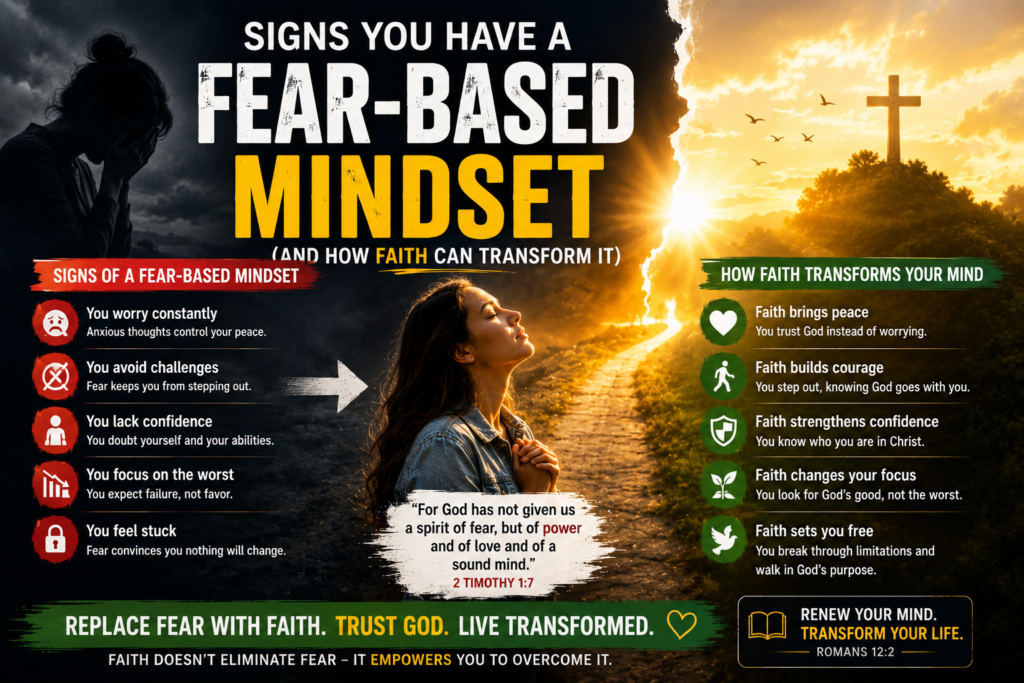
“For God has not given us a spirit of fear, but of power and of love and of a sound mind.” 2 Timothy 1:7
If fear isn’t from God, then a life run by fear isn’t the life He designed for you. The first step to freedom is recognizing fear for what it actually is. Let’s walk through the signs and then talk about what faith offers instead.
What Is a Fear-Based Mindset?
A fear-based mindset is a pattern of thinking where fear not faith, not love, not truth becomes the primary filter through which you see your life, make decisions, and relate to others.
It’s not always dramatic. Often it’s quiet, persistent, and so familiar that you don’t even notice it’s there. It feels like “just how I am” rather than a learned pattern that can be unlearned.
Here are the signs to watch for.
- You Avoid Decisions Because You’re Afraid of Getting It Wrong
Do you find yourself stuck in analysis paralysis, researching, weighing, delaying long after you have enough information to move forward?
Fear-based thinking treats every decision like it could be catastrophic. It whispers, “What if you choose wrong? What if you regret this? What if it doesn’t work out?”
Faith doesn’t promise you’ll never make a mistake. It promises you don’t have to be paralyzed by the possibility of one.
“Trust in the Lord with all your heart and lean not on your own understanding.” — Proverbs 3:5
- You Say Yes When You Mean No (Or No When You Mean Yes)
People-pleasing is one of fear’s favorite disguises. You agree to things you don’t want to do because you’re afraid of disappointing someone, being disliked, or causing conflict. Or you stay silent on a dream or opportunity because you’re afraid of what people will think if you go for it and fail, or even succeed.
This isn’t kindness. It’s fear wearing kindness as a mask.
“Rather, we will speak the truth in love, growing in every way more and more like Christ.” Ephesians 4:15
A faith-rooted mindset allows you to be honest and loving without needing everyone’s approval to feel secure. - You Constantly Imagine Worst-Case Scenarios. Do you catch yourself mentally rehearsing disasters that haven’t happened? Playing out the worst version of a conversation, a diagnosis, a financial setback, a relationship ending before there’s any real evidence it’s coming? This is called catastrophic thinking, and it’s a hallmark of a fear-based mind. It feels like preparation, but it’s actually a form of suffering in advance paying an emotional toll for something that may never happen. “Do not be anxious about anything, but in every situation, by prayer and petition, with thanksgiving, present your requests to God.” Philippians 4:6
- You Hold Back From Your Calling Because of “What If” Maybe there’s a dream, a ministry, a business, a relationship, or a bold step you know God has been nudging you toward — but you keep finding reasons to wait. What if I fail? What if I’m not ready? What if people judge me? What if it doesn’t work? Fear’s favorite move is to keep you in the waiting room of your own life. It makes delay feel responsible, when really it’s just fear in disguise. “Be strong and courageous. Do not be afraid or terrified… for the Lord your God goes with you; he will not leave you nor forsake you.” — Deuteronomy 31:6 God rarely calls people who feel fully ready. He calls people willing to walk by faith, not by certainty.
- You Struggle to Receive Love, Correction, or Help. Fear doesn’t just affect how you move forward — it affects how you relate to others. If you find it hard to receive love without suspicion, hard to hear feedback without spiraling into shame, or hard to ask for help without feeling like a burden, fear may be shaping your relationships more than you realize. This often traces back to a deep, unspoken fear: If people really know me, they’ll leave. If I need help, I’m weak. If I’m corrected, I’m not enough. “There is no fear in love. But perfect love drives out fear.” — 1 John 4:18. God’s love isn’t conditional, and it isn’t fragile. Learning to receive it fully is one of the most freeing parts of mindset transformation.
- You Feel Like You Need to Control Everything. Control is fear’s most exhausting disguise. If you feel a deep need to manage every variable, anticipate every outcome, and prevent every possible problem, it may not be diligence — it may be fear trying to protect you from uncertainty. The exhausting part? Control is an illusion. You were never actually able to control outcomes — only your obedience, your effort, and your trust. “Cast all your anxiety on him because he cares for you.” — 1 Peter 5: Letting go of control isn’t carelessness. It’s the deepest form of trust.
- Your Self-Talk Is Mostly Warnings, Not Encouragement. Pay attention to your inner dialogue for a day. Is it mostly: Be careful. Don’t mess this up. What if this goes wrong. You’ll probably fail anyway. Or is it: God is with me. I am capable through Christ. I don’t have to be perfect to move forward. Fear-based minds default to warning. Faith-based minds default to truth — which includes wisdom, but isn’t ruled by dread. “Finally, brothers and sisters, whatever is true, whatever is noble, whatever is right… think about such things.” — Philippians 4:8
Why Fear Feels So Convincing
Here’s something important to understand: fear isn’t always irrational. It often makes a lot of logical sense. That’s exactly why it’s so hard to recognize and so hard to release.
Fear says, “It’s smart to assume the worst — that way you’re never caught off guard.” It sounds responsible. It sounds protective. But it slowly shrinks your life, your faith, and your willingness to step into what God has for you.
The goal isn’t to eliminate all caution or wisdom — Scripture values both. The goal is to make sure fear isn’t the foundation your decisions are built on.
How Faith Transforms a Fear-Based Mindset
Faith doesn’t just suppress fear — it replaces its foundation. Here’s what that practically looks like.
Replace “What If” With “Even If”
Fear lives in “what if” — what if it goes wrong, what if I fail, what if I’m rejected. Faith lives in “even if” — even if it’s hard, even if I don’t understand, even if the outcome isn’t what I hoped, God is still good, and I am still held.
This shift — from what if to even if — is one of the most powerful mindset tools in Scripture (see Daniel 3:17-18).
Replace Self-Reliance With Surrender
Fear often comes from believing you have to control and protect everything yourself. Faith says you can release what you can’t control into hands far more capable than yours.
“Do not be anxious about anything… and the peace of God, which transcends all understanding, will guard your hearts and your minds.” — Philippians 4:6-7
Replace Isolation With Community
Fear isolates. It convinces you to deal with everything alone, to hide your struggles, to avoid vulnerability. Healing happens in connection — with God, and with godly community.
Replace Striving With Identity
A lot of fear is rooted in performance — the fear of not being enough. When your identity is anchored in who you are in Christ rather than what you accomplish, fear loses much of its grip.
“There is now no condemnation for those who are in Christ Jesus.” — Romans 8:1
A Simple Daily Practice to Shift From Fear to Faith
Each time you notice a fear-based thought arising, try this short practice:
1. Name it. “This is fear talking, not truth.”
2. Bring it to God. “Lord, I’m anxious about _. I bring this to You.”
3. Replace it with truth. Choose one scripture (like 2 Timothy 1:7 or Philippians 4:6-7) and speak it over the situation.
4. Take one faith-filled step. Even a small one. Faith grows through action, not just belief.
Over time, this practice rewires the default pathway your mind runs to — from fear, to faith.
You Were Not Made to Live Ruled by Fear
If you recognized yourself in several of these signs, take heart — awareness is the first step toward freedom, not a reason for shame.
God didn’t create you to live small, cautious, and controlled by what-ifs. He created you with a sound mind, a spirit of power, and a love that drives out fear. The life He has for you is bigger than the one fear has been negotiating you into.
If you’re ready to identify where fear has been quietly steering your life — and replace it with a mindset rooted in faith, truth, and courage — Christian mindset coaching can help you walk that transformation out, step by step.
[Book your free discovery call today] — and let’s move from fear to faith together.